

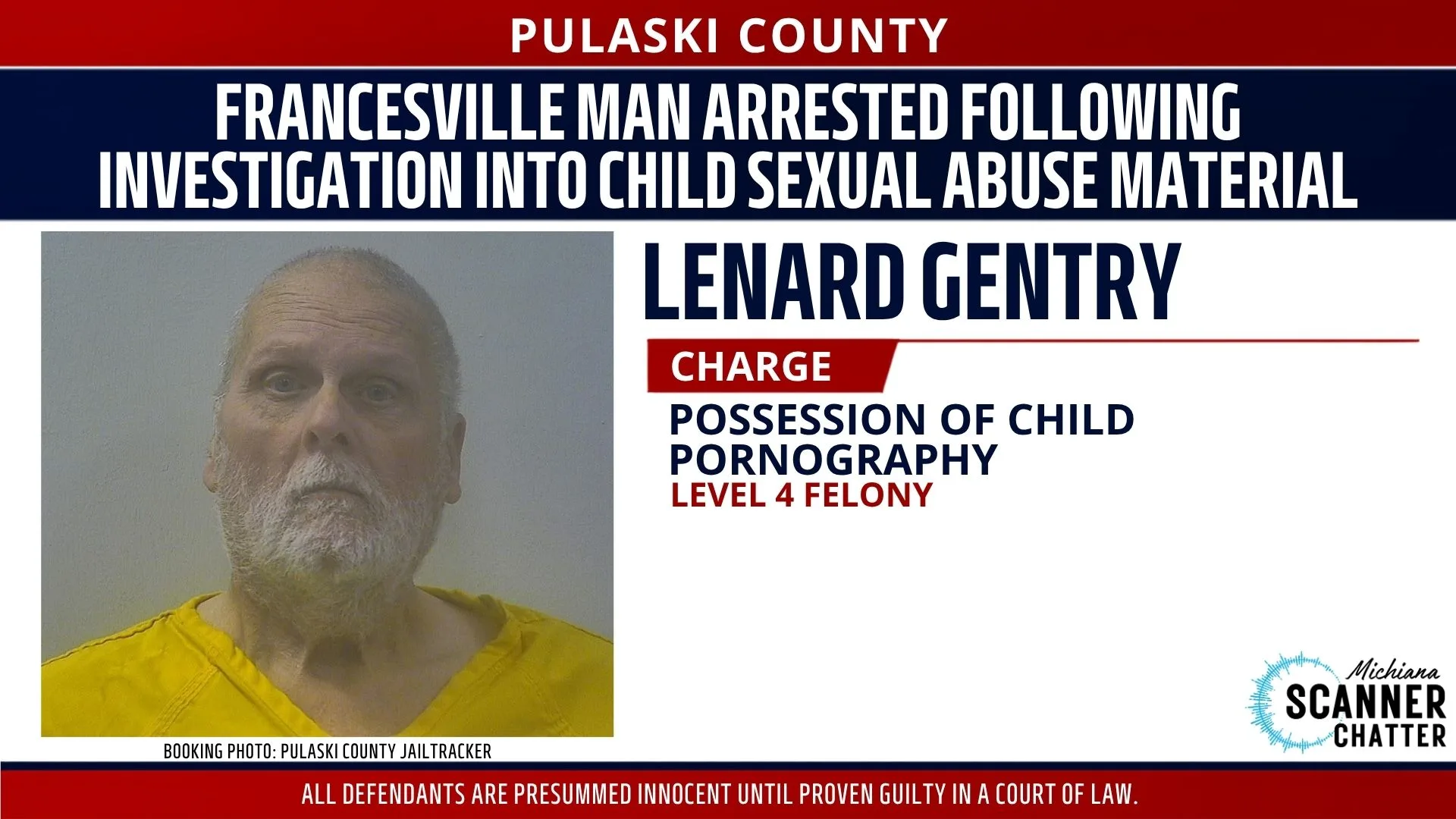
A 63-year-old Francesville man was arrested Sunday, October 25, following an investigation into suspected child sexual abuse material that developed after a video was brought to the attention of the Pulaski County Sheriff’s Office.
According to Chief Deputy Seth Barton, the Sheriff’s Office initially received a call for assistance Friday, October 23, after a group confronted Lenard Gentry over messages involving what was believed to be an underage victim.
Deputies learned the messages had actually been exchanged with a decoy account, which changed how they could approach the situation.
Barton explained that investigations involving decoy accounts operated by individuals outside law enforcement can create significant evidentiary challenges. He said the agency has been advised that cases involving those accounts will not be prosecuted because the investigations are not backed by law enforcement.
However, a video later sent to Barton provided a separate avenue for investigation.
According to the chief deputy, the video included statements from Gentry suggesting he had received and possessed child sexual abuse material. Because those statements were separate from the decoy account conversation, investigators were able to begin an independent investigation.
On Sunday, October 25, Barton and Detective Pickens followed up with Gentry. During that meeting, Pickens obtained additional information and Gentry’s device.
The investigation continued, and Gentry was taken into custody that evening.
According to Pulaski County Jail records, Lenard Leslie Gentry, 63, of Francesville, was booked into the jail at 11:44 p.m. on 10/25/2026 on an initial charge of possession of child pornography, a Level 4 felony.
Barton thanked members of the public who brought the information to his attention and emphasized the importance of cooperation between law enforcement and the community in identifying and addressing criminal activity.
Readers are reminded that charging information supported by an affidavit of probable cause is a mere allegation that a crime has been committed and that there is only probable cause to believe a crime has been committed. They are presumed innocent throughout the proceedings and are entitled to be represented by counsel and entitled to a trial by jury at which the State is obligated to provide proof beyond a reasonable doubt before a judgment of guilt may be made.